
Last updated October 17, 2026
 Metal roofing
 Architectural shingles
 Tile roofing
 GAF
GAF Owens Corning
 Flat & low-slope
Free roof inspection with deck photos before we talk money - GAF and Owens Corning certified installation
Roofing Warning Signs: A Orange County Homeowner’s Reference Guide
Walk any Orange County neighborhood after a rainstorm and you’ll see the same thing: homeowners glancing up at their roofs, squinting at a shingle or a patch of stucco, then heading back inside. Most of them will do that same glance for another eighteen months before a ceiling stain appears in the living room. This guide exists because Southern California’s forgiving climate is a terrible early-warning system. No ice dams to rip flashing loose, no freeze-thaw cycles to split shingles overnight, no six-month winter to force a decision. Just long dry stretches that let small problems set up housekeeping. By the time an Orange County roof sends a signal loud enough to interrupt dinner, the quiet damage underneath has usually been running for a year or two. We’ll show you the warning signs that matter here, the ones specific to clay tile, concrete tile, and asphalt shingle roofs in this climate, in our Complete Guide to Roofing in Orange County.ate, and tell you which ones you can safely watch versus which ones deserve a phone call this week.
Quick Answer
The roofing warning signs Orange County homeowners most often miss are interior wall stains near the ceiling line, a musty attic smell that comes and goes, granules collecting at the bottom of downspouts, and cracked or shifted clay tiles that still look fine from the street. In this climate, most of these signals appear weeks or months after the actual damage begins, because rain is infrequent and evaporation is fast. If you can see a water stain of any size, or if you find roof granules in your gutters more than once, the roof has already been compromised and you should schedule an inspection rather than waiting for the next rain.
Styles & brands we work with
Table of Contents
- Interior Warning Signs: What’s a Roof Problem and What Isn’t
- Clay and Concrete Tile: Mortar Deterioration and Field Tile Cracks
- The Attic Stain Test: Active Intrusion vs. Old Cosmetic Staining
- Post-Santa Ana Wind Damage: Signs That Differ From Rain Damage
- Asphalt Shingle Warning Signs in Orange County
- Repair vs. Replacement: The Line Nobody Wants to Cross
- How to Inspect Your Own Roof Safely (Without a Ladder)
- Common Mistakes to Avoid
Interior Warning Signs: What’s a Roof Problem and What Isn’t
A brown water stain on a bedroom ceiling in Orange County sends most homeowners to two places first: the air conditioning contractor or the plumber. That’s understandable. Southern California homes run their AC nine months out of the year, condensation lines clog, and water heaters fail. But before you pay a service call to the wrong trade, there’s a quick way to strong>rule out the roof.
Roof-related interior stains follow a pattern. They appear on the ceiling, not the wall, and they tend to be at the highest point of the room where the ceiling meets an exterior wall or underneath a bathroom vent pipe. They grow slowly between rains, often darkening along the edges while the center stays pale. If the stain sits directly below a bathroom or kitchen on the second floor, that’s probably plumbing. If it sits below the attic, and especially if the attic is unfinished, that’s almost always the roof. We saw a home in Fullerton last year with a stain the owner assumed was a failed AC condensate pan. It was a pinhole in a two-story valley flashing that had been leaking for three seasons. The AC unit was fine.
Here’s a simple three-step rule-out we give Orange County homeowners:
- Trace the stain’s location. Directly below a second-floor bathroom or kitchen? Look at plumbing first. Below an attic, vaulted ceiling, or exterior wall? Roof is the likely suspect.
- Track the stain across seasons. Mark the stain’s edges lightly with a pencil. If it grows after rain, it’s roof. If it grows during heat waves, it might be condensation or HVAC-related.
- Check the ceiling texture. A roof leak will often cause paint to bubble or peel in a ring around the stain. Plumbing leaks tend to leave a single, saturated patch.
Musty attic smells are another signal that gets blamed on everything except the roof. Orange County’s dry climate means an attic should never smell of wet wood or damp insulation. If yours does, especially after a few hot days following a rain, that’s trapped moisture. It could be inadequate ventilation. More often, it’s a small intrusion point at a pipe boot, a skylight, or a valley where water enters, soaks the decking, and then bakes in the Southern California sun. The smell fades as the wood dries, which convinces homeowners the problem fixed itself. It didn’t.
Interior signs for the Roof Repair in Orange County trade to evaluate are rare in this climate, which is exactly why they’re easy to misread. A stain that appears once and never recurs might be sealed. A stain that reappears every winter, however faintly, is active.
Clay and Concrete Tile: Mortar Deterioration and Field Tile Cracks
Orange County is tile country. Walk through neighborhoods in Tustin, Orange, Villa Park, or Yorba Linda and you’ll see thousands of clay and concrete tile roofs, many of them thirty, forty, or fifty years old. Tile is a remarkable material, and when it’s installed correctly it can last longer than the house around it. But tile roofs fail in two predictable ways here, and neither one is a dramatic cave-in.
The first is mortar deterioration. The ridge caps and hip lines on a tile roof are bedded in mortar, the same sand-and-cement mix used for tile setting on a floor or wall. Orange County’s long dry summers pull the moisture out of that mortar year after year. The sun’s UV does the rest. The result is hairline cracks that widen slowly until small chunks of mortar break away. You’ll see them in your gutters, or scattered on the ground below the ridge line. From the street, the ridge looks slightly fuzzy, like a sweater starting to pill.
What does failing mortar look like up close? Instead of a smooth, solid bead sealing the gap between ridge tiles and field tiles, there are fissures, crumbling edges, and in advanced cases, open voids where birds have begun to nest. When the mortar fails, the ridge tiles lose their seal. Wind-driven rain penetrates the gap during a Santa Ana event or a rare downpour, and water enters along the highest point of the structure. This is a classic Tilehurst Roofing Orange County home repair scenario, because by the time a homeowner notices the broken mortar, the underlayment beneath has often been exposed for a full rainy season.
The second failure mode is cracked field tile. This is easier to spot once you know what to look for. A cracked clay tile shows a clean, sharp fracture line, often running vertically along the barrel curve. The crack may be hairline or wide enough to see daylight through. A concrete tile crack is usually a spalled edge, a flaking surface, or a full split across the tile’s flat face. From a ladder at the gutter line, you might see cracked tiles that still sit in place, which makes them easy to dismiss. A cracked tile that hasn’t shifted is still a leak risk. Every crack is a seam where water can enter and run along the underlayment, often surfacing ten or twenty feet away from the actual break.
Normal weathering on tile looks different. A weathered tile shows surface color fading, subtle efflorescence (a whitish mineral bloom from the concrete or clay body), or minor edge wear. That’s cosmetic. A structural crack is an opening. If you can slip a fingernail into it, water can follow it.
The Attic Stain Test: Active Intrusion vs. Old Cosmetic Staining
Every attic that has been through a Southern California winter has at least one stain on the underside of the roof decking. Most of them are old, sealed, and harmless. Some are not. Distinguishing the two is the single most useful skill an Orange County homeowner can learn before calling a roofer, because it prevents both false alarms and dangerous procrastination.
Here is the moisture test we recommend, step by step:
- Wait for a dry spell of at least 72 hours. Do not test within three days of rain. You need a baseline of dry conditions.
- Go into the attic during daylight hours with a flashlight and, if possible, a moisture meter (a basic one costs under $40 at any hardware store).
- Locate the stain on the underside of the decking. Note its shape, darkening at the edges, and any white or gray rings around the perimeter, which indicate repeated wetting and drying cycles.
- Touch the stain with your bare hand. Cool or damp to the touch in dry weather is a sign of trapped moisture. If you have a meter, press the pins into the stained wood and an adjacent unstained area for comparison. A reading above 20 percent moisture content in the stained area after 72 dry hours is an active leak.
- Look for residue trails. Active leaks leave a path: a darker line running from the stain toward the closest penetration (a vent pipe, chimney, or valley). Old, sealed stains are self-contained with no trail, and the wood around them feels identical to the rest of the decking.
A cosmetic stain in an Orange County attic is usually a soft-edged brown or gray patch, often fading into the surrounding wood without a clear border. It may date from a past leak that was repaired years ago. An active intrusion point shows a stain with defined edges, possible white mineral residue, and during cool mornings, a slight damp sheen.
If the test is inconclusive, you can run a second test from below: tape a sheet of aluminum foil to the underside of the decking across the stain. Leave it for a week. If condensation forms on the foil’s underside, there’s moisture moving through the decking. This is a low-tech, reliable method used by inspectors across Southern California, and it gives you a definitive answer without touching the roof surface.
Post-Santa Ana Wind Damage: Signs That Differ From Rain Damage
Santa Ana winds are the most underrated roofing threat in Orange County. Rain gets all the attention because water damage is visible. But wind damage is structural, and it sets the table for the next rain to do its worst. After a sustained Santa Ana event (steady winds of 30 to 50 mph with gusts to 70 or more), there are specific signs that appear on tile and shingle roofs that you won’t see after a quiet storm.
On a tile roof, look for shifted or lifted tiles near the hips and ridges, where wind turbulence is greatest. A tile that has lifted just a quarter inch will not reseat itself. It now has a gap underneath, and the next rain will drive water horizontally into that gap. Also look for tiles that have slid slightly down-plane, so the overlap between rows is reduced. On a concrete tile roof, a row that has moved even two inches can expose the underlayment below. From the ground, a shifted tile roof looks slightly misaligned, like teeth that have moved after braces come off.
On an asphalt shingle roof, look for lifted shingle tabs on the windward slopes. A shingle that has lost its seal will sit slightly proud of the shingles around it. Run your hand (or look closely, if you’re on the ground) along the edge and you’ll see the difference: a properly sealed shingle lies flat, while a lifted one has a visible air gap. Also check for shingles in the yard or against the fence line, especially after strong gusts. A missing shingle on a roof that’s over ten years old often means the sealant strip has reached the end of its life, and more shingles will follow.
We’ve responded to post-wind damage calls in Anaheim Hills and Mission Viejo where the damage wasn’t visible from the ground. The homeowner only discovered it when the rain came and a bedroom ceiling stained. After a Santa Ana event, walk the perimeter of your house and look up at the roof line with binoculars. Check the ridge, the hips, and the valleys. If you can see an air gap anywhere, call a roofer before the next rain. This is one of the times when the Roofing Company in Orange County label matters: you want someone who has seen this exact wind pattern damage and knows where to look.
Asphalt Shingle Warning Signs in Orange County
Asphalt shingle roofs are the most common roof type in Orange County’s tract home neighborhoods, especially in cities like Irvine, Lake Forest, Aliso Viejo, and Rancho Santa Margarita. Shingles are durable and affordable, but they degrade here in a specific pattern that’s worth understanding.
The first warning sign is granule loss. Asphalt shingles are covered with ceramic granules that protect the asphalt substrate from UV radiation. In Orange County, where the sun shines 280 days a year, those granules slough off continuously. You’ll see them at the bottom of downspouts, on the driveway below the roof edge, or in the gutters themselves. A teaspoon of granules after every rain is normal wear. A quarter-cup collection in a single gutter run, or a visible streak of bare asphalt showing through the granule layer, is not.
The second sign is shingle curling. Curling appears as the corners of individual shingle tabs lifting upward, or the entire shingle cupping along its length. In Orange County’s dry heat, curling is primarily a sign that the shingle’s asphalt has dried out and lost its flexibility. A curled shingle catches wind, and a wind-caught shingle tears. Once curling starts, it usually affects an entire slope within a year or two.
The third sign is flashing failure. Flashing is the metal material (aluminum, galvanized steel, or copper) that seals the joints where the roof meets a wall, chimney, skylight, or valley. It’s the most common failure point on any asphalt shingle roof, and the most common repair we perform on a Roof Replacement in Orange County property, even when the shingles themselves still have years left. Failed flashing shows up as rust streaks, raised or separated metal edges, missing sealant at the seams, or nails that have popped and left holes. Flashing failure is also the leading cause of interior ceiling stains in two-story Orange County homes, because the water travels along the roof truss and surfaces far from the original entry point.
A less-discussed but extremely common sign is nail pops, where the roofing nail that fastens a shingle works its way back up through the shingle surface. You’ll see small raised bumps across the roof, each one a potential entry point for water. On a roof over 15 years old, nail pops in multiple locations signal that the decking has begun to flex and the shingles are loosening. Repairs at that stage are stopgaps, not solutions.
Repair vs. Replacement: The Line Nobody Wants to Cross
Every Orange County homeowner wants to hear that the roof needs a repair, not a replacement. Repairs cost hundreds of dollars. Replacements cost thousands. The math seems simple, but it’s actually the most expensive miscalculation in this guide when you look at it over a five-year window, a topic we explore fully in our DIY vs Professional Roofing: The Orange County Homeowner’s Decision Guide.
Here’s the line we draw, and it’s the same line most ethical Orange County roofers draw:
Repair territory: the roof is under 15 years old for asphalt shingles, or under 30 for tile, and the damage is isolated to one of these areas: a single flashing point, one valley, a few cracked field tiles, a short ridge run, or a discrete leak around a pipe boot or skylight. The rest of the roof shows no signs of granule loss, curling, cracked tile, or failed mortar. Repairs in this scenario can extend the roof’s life by five to fifteen years.
Replacement territory: the roof is over 20 years old (for shingles) or over 40 (for tile), and you’re seeing multiple warning signs simultaneously: granule loss plus curling plus nail pops. Or cracked tile across more than 20 percent of the field, plus deteriorated mortar along the ridge and hips. Or a roof that has already had three or more repairs in the last five years. In this scenario, the roof’s components are failing together, and each repair you make is a down payment on the repair you’ll need next year.
The reason waiting past this line costs more, not less, is structural. The underlayment beneath shingles or tile is the real waterproofing layer. Once multiple intrusions have occurred, the underlayment begins to degrade. Each month that passes, more water reaches the decking, and decking replacement goes from a possibility to a certainty. A roof replacement that would have cost $18,000 with minor decking replacement becomes a $22,000 job with full decking replacement. We’ve quoted this exact scenario in Huntington Beach and Santa Ana more times than we can count.
For tile roofs specifically, there’s a middle path: a tile re-lay. Intact tile can often be removed, the existing underlayment replaced, and the original tile re-installed. This costs significantly less than a full tile replacement and preserves the original look of the home. It’s an option most Orange County homeowners don’t know exists, and it’s one of the reasons a written estimate from multiple roofing companies in Orange County is worth obtaining before committing to anything.
How to Inspect Your Own Roof Safely (Without a Ladder)
Walking a roof is dangerous, especially on wet mornings or on two-story Orange County homes where the pitch is steep. The good news is you don’t need to. A thorough ground-level inspection, repeated twice a year and after every major rain or wind event, will catch 90 percent of the warning signs in this guide.
Here’s the sequence we recommend:
- Use binoculars. A cheap pair of 10×42 binoculars from any sporting goods store will show you individual shingles and tiles from the ground. Stand at the four corners of your house and scan each slope systematically, left to right, ridge to gutter.
- Check the ridge first. This is the highest point of the roof and the first place wind damage shows. Look for opened mortar joints, lifted ridge caps, or shifted tiles.
- Scan the valleys. The valleys where two slopes meet are the busiest water channels on any roof. Look for cracked tile, exposed underlayment, or shingles that have folded or lifted at the valley edges.
- Look at the flashing points. Chimneys, skylights, vent pipes, and where the roof meets a wall are all flashing locations. Look for rust, gaps, lifted metal, or missing sealant.
- Walk the gutter line. Use your phone to take photos from directly beneath the gutter, looking up along the drip edge. This shows you the underside of the first course of shingles or tile, where wind damage and water intrusion often begin.
- Document everything. Take photos from the same spots every six months. Side-by-side comparison shows movement and change that the eye misses when looking at a roof once.
The gutter check is also your easiest granule and mortar monitoring system. After every rain, walk your gutters and note what’s accumulated. Granules, small pieces of mortar, and roofing cement crumbs all tell a story about what’s degrading above. Clean the gutters each spring and fall, and pay attention to what you’re removing. A gradual increase in granules over a year is normal. A sudden jump after a wind event is not.
In our experience, Orange County homeowners who do this twice-yearly inspection and keep the photos on a phone catch roof problems years before their neighbors do, and their repair bills reflect that discipline. Roofing is one of the few home systems where early detection actually changes the outcome, because a small flashing repair is a completely different animal than a full roof replacement. For more guides & resources, visit our blog.
Common Mistakes to Avoid
- Ignoring a ceiling stain because it’s “small and old.” No stain is old unless you know exactly when it first appeared and have confirmed it’s sealed. Unwatched stains grow, and by the time they’re undeniable, the decking beneath is already compromised.
- Assuming a roof leak is a plumbing or HVAC problem. In Orange County, where attic heat and AC condensation are constant, it’s easy to misattribute a ceiling stain. Run the three-step rule-out from earlier in this guide before calling a plumber.
- Caulking a flashing seam from inside the attic. Sealant applied from the underside of a leak never works. Water finds a new path around it. The repair must happen on the roof surface, where the flashing and underlayment actually seal.
- Power-washing a tile roof to “clean it up” before selling a home. The high pressure of a power washer strips the tile’s protective surface and pushes water under tiles where it has no business going. A tile roof should be cleaned with soft washing or left alone entirely.
- Waiting until the rainy season in Orange County to inspect a roof. The day after a January storm, every roofer in the county is booked. Inspections in September and October, when roofing crews have open capacity, mean faster response and more flexible scheduling when a problem is found.
- Choosing a repair contractor based only on the lowest bid. A repair that fails inside a year costs more than a proper repair at a fair price. Ask for a written guarantee before work starts, not after. At Tilehurst Roofing, every repair gets a written guarantee delivered before the crew leaves, not mailed later.
- Ignoring wind damage because “there wasn’t any rain with it.” Wind damage is a leak waiting to happen. The Santa Ana winds can lift a tile, break the seal on a shingle, or pull flashing away from a wall. The next rain finds it. The time to fix it is the week after the wind, when the roof is dry and the damage is fresh.
See the difference
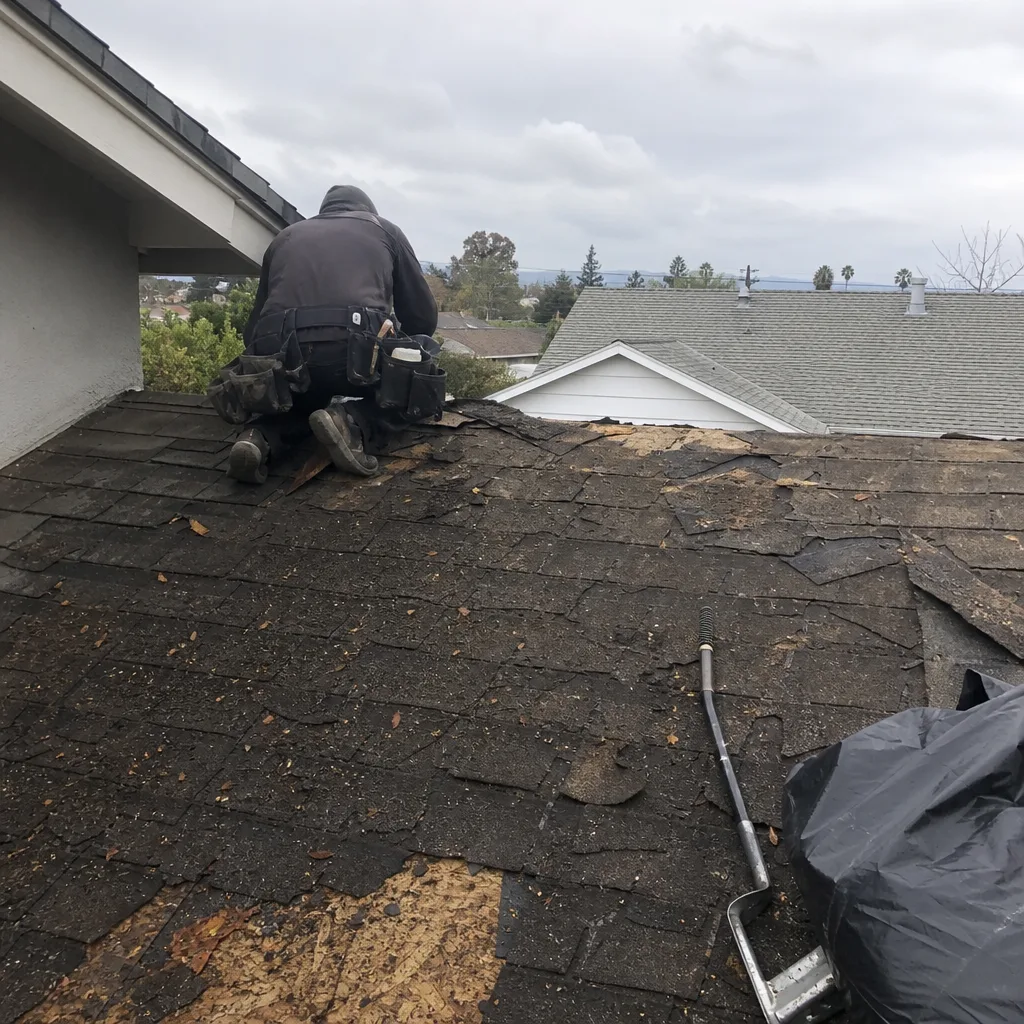 Before
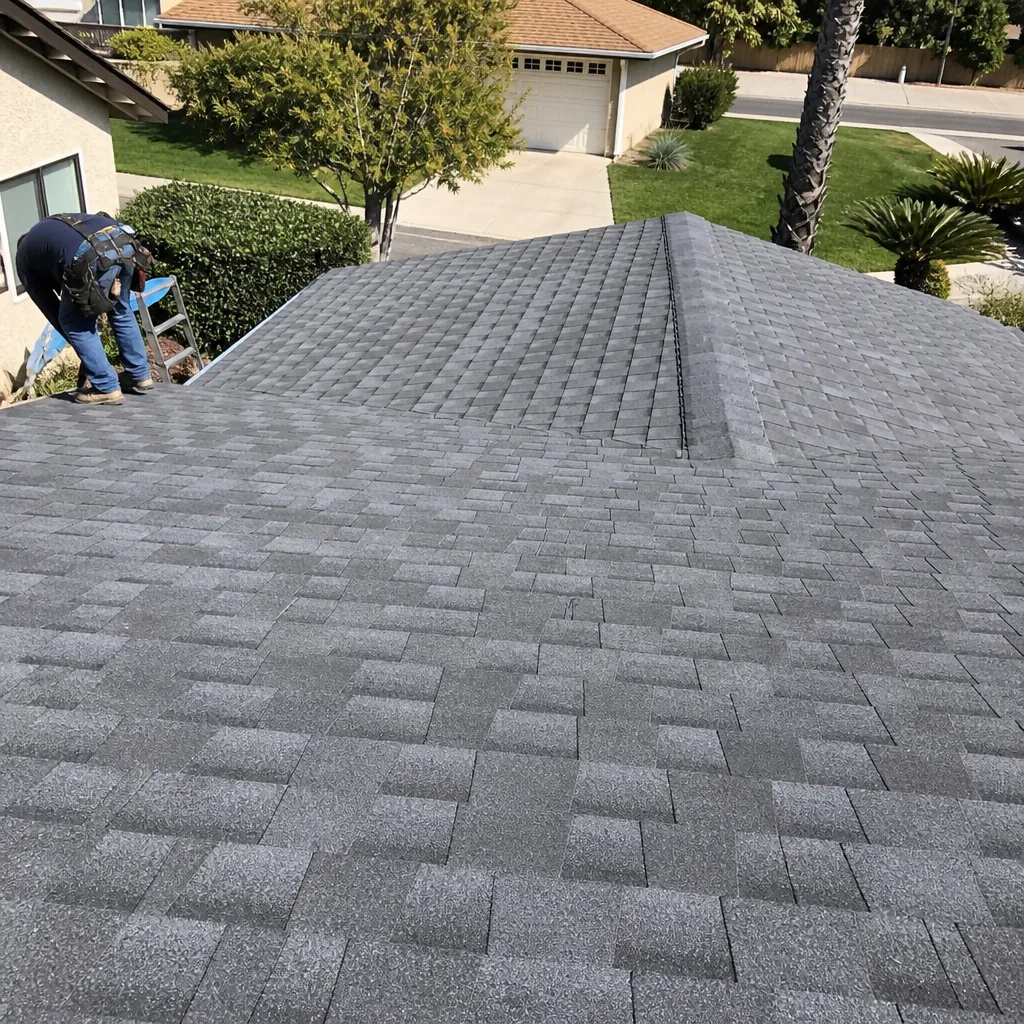 After
After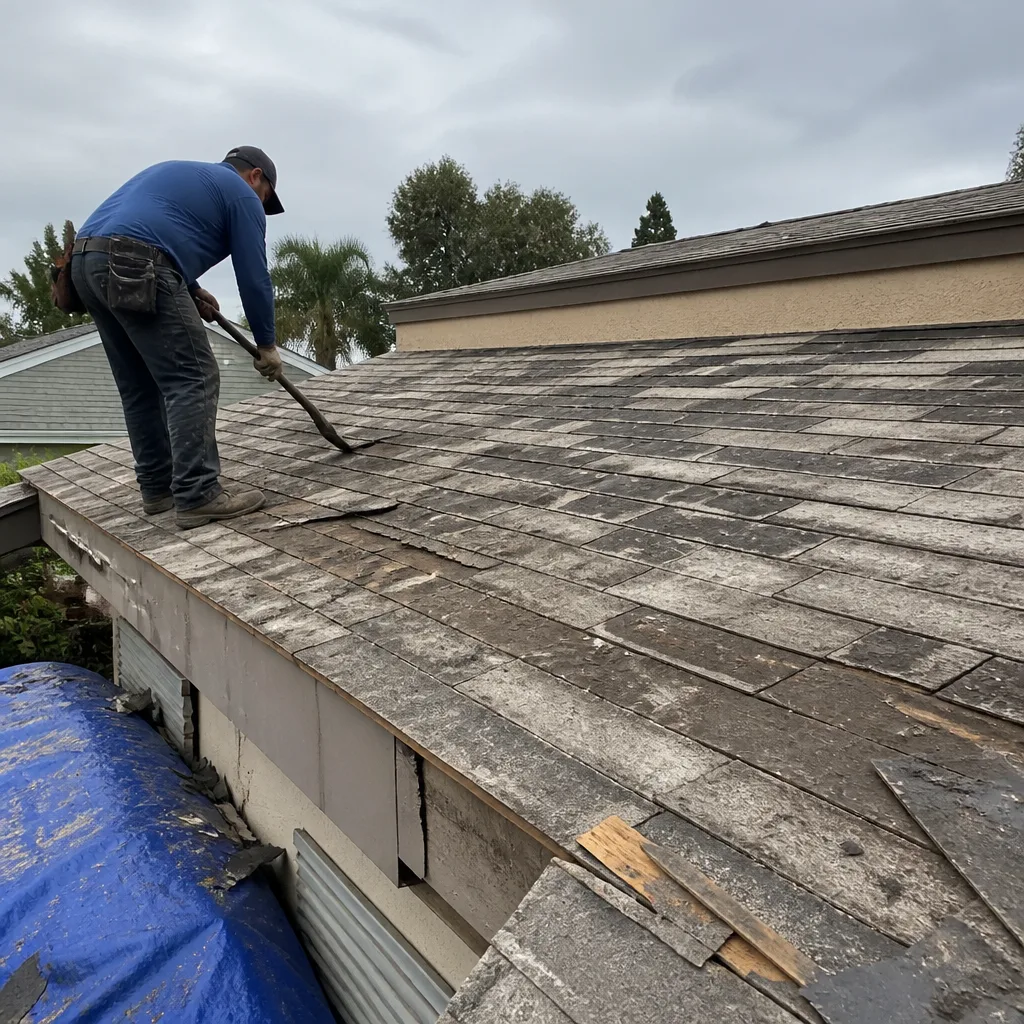 Before
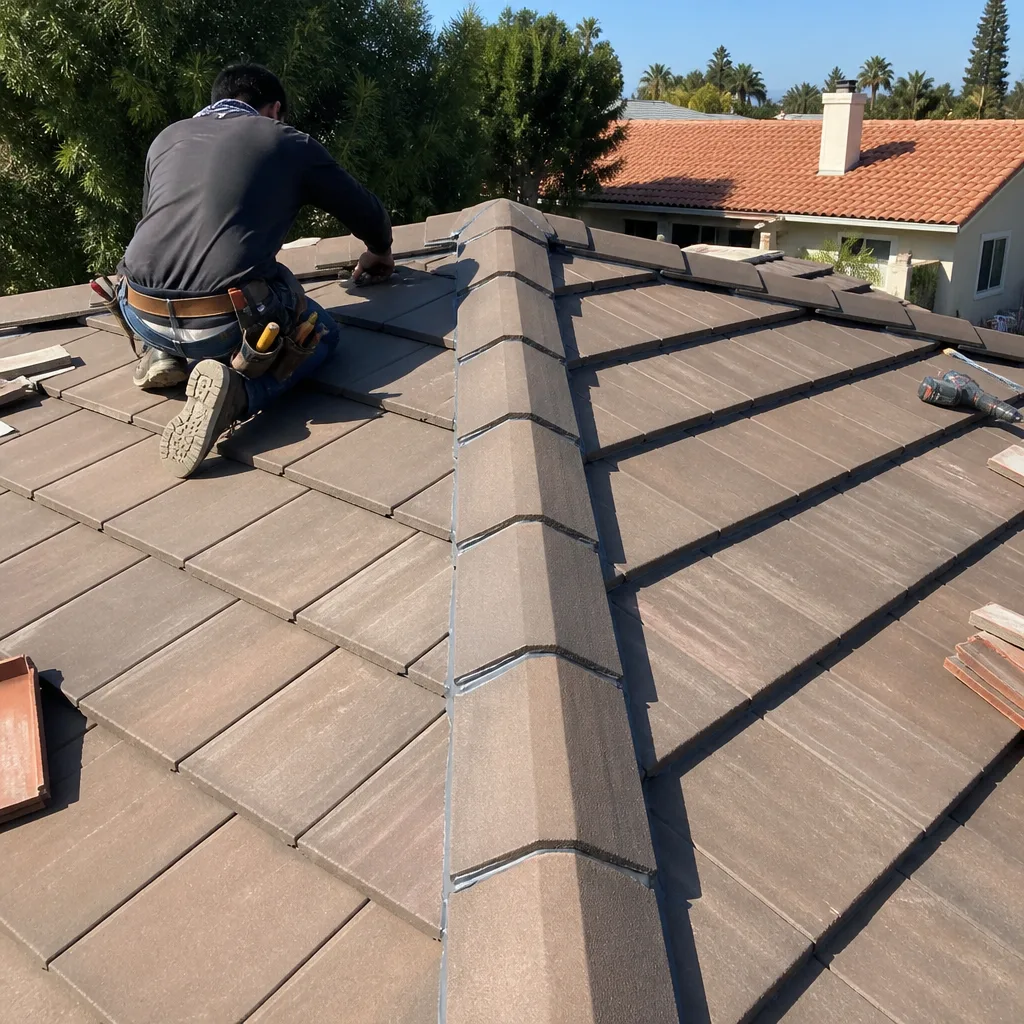 After
After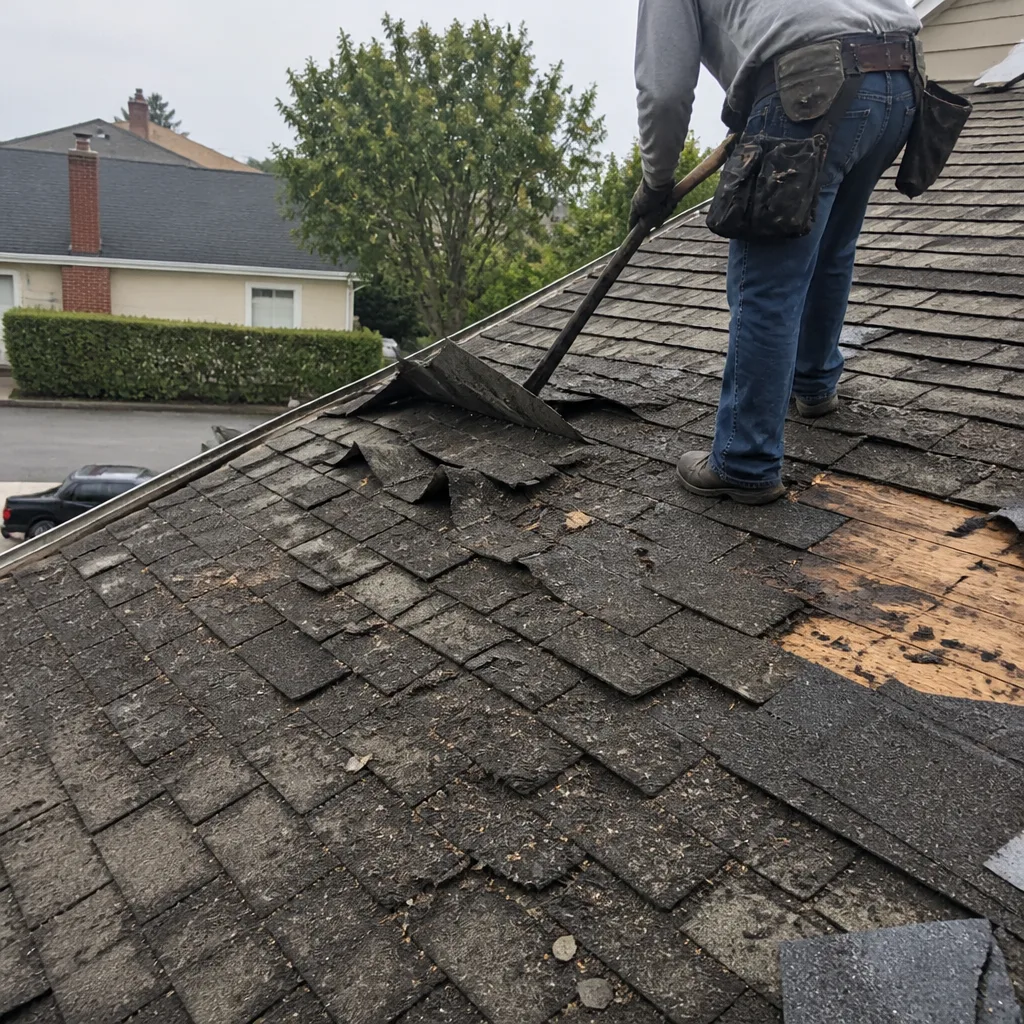 Before
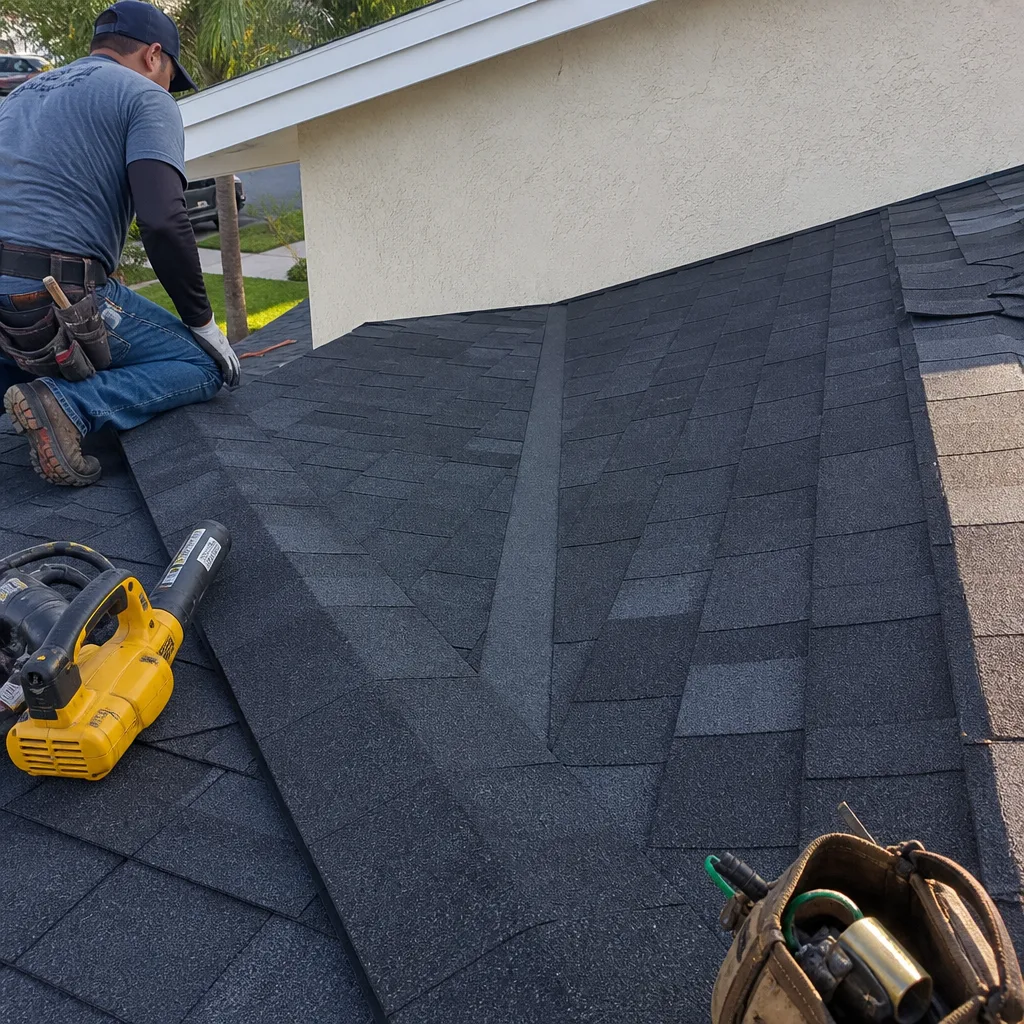 After
AfterWhen to Call a Professional
Call a professional if you find a ceiling stain that recurs, if the attic moisture test indicates an active intrusion point, if you spot cracked or shifted tiles from the ground, if your gutters are filling with granules or mortar fragments, or if a Santa Ana wind event has visibly disturbed any part of the roof surface. Each of these is a signal that the roof’s waterproofing has been compromised, and in Orange County’s dry climate, every month of delay gives moisture more time to move through the decking and into the home’s framing. Tilehurst Roofing Orange County offers free estimates throughout Orange County, with a written price in your hands before any work starts. Call (559) 295-5445 to schedule yours, whether you need a specific repair diagnosed or a full roof assessment.
Frequently Asked Questions
Most asphalt shingle roof repairs in Orange County run between $350 and $900 depending on the scope of the intrusion and the materials involved. Tile roof repairs typically run between $500 and $1,500, largely because tile work is more labor-intensive and often requires matching existing tile profiles. Flashing repairs at chimneys, skylights, or wall intersections are the most common repair, and they typically run $400 to $800. These are realistic market ranges, but every roof is different, so call (559) 295-5445 for an exact quote. Estimates from Tilehurst Roofing are free and the written price is in your hands before any work begins.
It shouldn’t, and at Tilehurst Roofing, it doesn’t. We put the written price in your hands before any work starts, and we don’t issue change orders for work we bid. The only legitimate circumstance where a price might change is if additional damage is discovered beneath the surface that could not have been seen during the initial inspection, and that should be explained and approved by you before any additional work proceeds. If a contractor’s price creeps upward after the work begins, without new information, that’s a red flag. The Kingswell Way is to say the price before the work, and keep it.
Most cities in Orange County require a permit for roof replacements and for repairs that affect more than a small area of the roof surface. The specific threshold varies by city, and some cities have stricter requirements than others. A licensed roofing contractor will know the permitting rules for your specific city and will pull the permit as part of the job. If a contractor suggests skipping the permit to save money, walk away. A permitted roof with a passed inspection is your protection when you eventually sell the home.
Most standard roof repairs in Orange County are completed in a single day, and often in half a day. A flashing repair, a few cracked tiles, a ridge mortar touch-up, or a shingle replacement all fall into this category. Larger repairs that involve multiple areas, decking replacement, or re-laid tile sections may take two to three days. The specific timeline depends on the roof’s accessibility, the materials involved, and the weather. As with any quote, the timeline should be written down before work starts.
A single cracked tile is not an emergency in the same way a two-foot section of missing shingles before a storm is, but it is a genuine leak risk that gets worse with every rain. A cracked tile in the field of the roof, where water runs over it, is more urgent than one near the ridge where water exposure is brief. In either case, you want it replaced before the next storm cycle. The reason to act quickly on a cracked tile in Orange County is that the underlayment beneath it is now your only waterproofing barrier, and underlayment degrades when exposed to rain and heat.
The decision comes down to the roof’s age, the number and spread of failures, and the condition of the underlayment and decking. As a rule of thumb: a roof under 15 years old (shingles) or 30 years (tile) with isolated damage is a repair candidate. A roof over 20 years old (shingles) or 40 years (tile) with multiple simultaneous failures is a replacement candidate. The only way to know for certain is with a physical inspection of the roof and attic. An honest contractor will show you photos of what’s failing and explain the math. That’s a free estimate, so there’s no reason to guess. Call (559) 295-5445 and we’ll walk the roof with you and show you exactly what we see.
The Bottom Line
Warning signs on an Orange County roof are easy to dismiss because this climate rarely forces a decision. No ice dams, no snow load, no months of relentless rain. Just a dry, sunny environment where moisture evaporates, stains fade, and a small intrusion point can hide for years while it quietly rots the decking. The signals are there if you know where to look: a ceiling stain in the wrong place, granules in the gutter that keep appearing, crack lines in clay tile that shift every time the wind blows, and mortar crumbling from the ridge of a tile roof in Tustin or Yorba Linda. Watch them, and they’ll show you the truth. What you do after that is the difference between a $500 flashing repair and a $22,000 roof replacement. This guide exists to make that choice clear. Tilehurst Roofing is here to make the repair honest, guaranteed, and priced before the work starts. Call (559) 295-5445 any time, day or night. A live person answers.
Written by Greg Holloway, Owner at Tilehurst Roofing Orange County, serving Orange County since 2000.